
Timeless London #6 Haynie Sze
Updated: Jan 29
藝術其實是我去看建築的另一個窗口。
時:2025年12月6日,下午五時
地:South London
人:史穎怡 Haynie Sze

認識Haynie,是我十九歲的時候的事。當時作為高中生的我很愛去不同的文學講座和活動,
和她的第一次見面,應該是某次在九龍城某個活動過後,因為和幾位香港作家們一起去吃
泰國菜,她也在其中,自此就不時聯絡。從那時候起,她一直喚我「妹妹」,一個十分可愛
的稱呼;我知道她是位建築師,同時也喜歡做和藝術相關的事。跟她的第一次「合作」,是她
當時參與「藝聚政府大樓」計劃(2013-14),民政事務局委約她在中環郵政總局放設名為
「信‧念」的藝術裝置:她邀請了不同文化界人士親手寫下書信,而我竟然有幸也提供了兩篇書信,Haynie把這些手寫的字體印在窗上,配上郵居對面怡和大廈(Jardine House)著名的一個個圓形窗口,實在特別有趣味。
如今,這重要的中環郵政總局居然要拆卸了,我也不再是個「妹妹」,早在八年前獨自來了
英國生活。想不到後來,Haynie也搬來倫敦,正開始著她的新生活。所以我想,不如就讓她也成為Timeless London的嘉賓,請她說說建築和藝術兩大題目。因為彼此都很忙,這個
訪問是在線上進行的,但說到激動處我們仍會對著螢幕互相敬酒,猶如我們就在對方身旁。

你從哪裡來?為什麼會在倫敦生活?
我來自香港,是一位建築師。我在香港出生、長大、生活,建立自己的事業。我不介意透露
我已四十多歲,是個中年女士了(笑)。到了這個年紀,我才發現從小到大,我都在做一些很
循規蹈矩的、所謂「對」的事,我覺得有點不妥。這種不妥,不是一種表面上有甚麼失敗了
的不妥,而是心底裏,你知道有點東西你是若有所缺,或者覺得有點事不應該是如此的感覺。
這令我感受很深:「不妥」浮了上來。我的路一直很清晰,特別在香港社會來說。但我其實
一直把心中的desire按住了,到了這刻才爆發。當然也有外在因素,例如社會的事、香港的
問題、自己人生的際遇等等,集合起來令我想踏出去試,去找我的missing puzzle。而英國這個地方,可以讓我們留下超過一年,我就想,我希望試試在壓力比較小的環境之中生活。
上天給了我很多,我覺得我的下半場不能就這樣完,否則會對不起自己的人生。「不妥」就是轉機,如果此刻不轉,就只會一直重複以前而已。所以我就轉轉,轉來倫敦試試去做我心底內真正想做的事。
可以談談你和建築之間的關係嗎?為什麼當初選擇做建築師?
每次人家要我介紹自己、形容自己,我的職業總離不開是第一件我會談的事,這也是我的
身分:我是一個建築師。雖然我目前正向藝術方面發展我的工作,但建築師是我的
core identity。
說起來,選建築是因為我是個很「乖」的小朋友。我的學業成績一向很好,也很能做到社會和父母對我的期望。上天給了我一些小聰明,成績優秀令我可以選這科。但是,做到和喜歡是
兩回事,中學時我明明一直喜歡文科,但我沒有選讀,因為在我的年代,理科的出路多很多。雖然我清楚知道我文科的腦比較強:語言、視覺、理論等等,但我把我的特質放了在次要,
而選了雖然不太喜歡,但出路更有保障的理科。我的家庭也是草根,靠我一畢業就撐住各人,所以選大學和主修科的時候,填了很多自己並不喜歡的engineering,而選建築,是因為它
似乎是文科和理科中間,既可以畫畫設計、做好看的空間,但也有理論、要把有功能性的東西建造出來,我覺得這是個平衝。我放棄了真正喜歡的文科,最後選了建築,在中文大學 ── 一間非常好的大學畢業。

建築這行是怎樣的呢?
建築是一個需要長時間投入的行業、一條十幾年都走不完的路。由大學的Year 1開始,
讀建築系是五年,加上一年的實習,再有兩年未有建築師牌照的職場試煉。你要不斷去
儲蓄經驗,再去考牌(通常要兩至三次才行)。當同齡的朋友成家立室、事業上開始有
成就之際,你的道路才剛展開;考取牌照後,你甚至會發現自己原來甚麼都不懂 ──
因為這行實在太廣泛了,如果你做過的項目是興建學校,那麼你不會懂得興建住宅,
因為兩者是完全不同的兩回事。
職場上,它的重複性很強、很systematic。這行規範多、分工細,團隊很大,因為複雜程度高,牽涉到的人實在太多,和讀書時的想像很不一樣,那些建築大師真是萬中無一,不是
大家所想的拿著畫圖在地盤就能呼風喚雨;工作也很辛苦,要常常捱夜趕deadline,設計要
出得快,而且改很多次。開一個project meeting,只少會有二十個部門代表:結構工程師、機電工程師、測量師、園景師…… 光是建築,又牽涉到燈光設計、外牆設計等等。
如果你是個感性而且對自己的作品很執著的人,你會很辛苦,而我正是這種人,沒辦法一做完這個步驟就丟給下一個步驟的負責人,但理性些的人或者可以吧。後來到了我做得真的很辛苦的時候,就決定離開這個環境。

當你決定辭退全職建築師工作後,你有沒有一個清晰的方向,或者是一些事想去做的呢?
沒有的。我現在做的是轉型,一切都需要摸索。而這個轉型是有過程的,在2019至21年,
當時工作上有空間,我讀了一個兼職Fine art碩士,那真是一個非常好的窗口,令我接觸
藝術,以我作為建築師的身分去探索:我可不可以用藝術這個媒介去做到甚麼?
我覺得傳統的建築崗位可以不只是如此,建築學是很大的,我可以用另一角度去看,而藝術
其實就是我去看建築的另一個窗口。讀Fine art時,我離不開去做空間性的東西,例如做
裝置、3D藝術品,背後的理念,都是我對世界、社會、「人的身體身處在空間裏面」的種種思考。譬如空間給我們的掣肘和壓迫、對於我們身心靈狀態的影響是甚麼,而我有甚麼回應去塑造回我們身處的空間呢?就是去想這種循環。
當然,這兩年的我也有點迷失,因為我想探討的東西,沒有框架也沒有指引,跟以前人生
總有清晰路向很不同,現在我是個「文科人」了。讀完碩士之後,我正式辭去全職的建築師
工作,我嘗試了很多不同的東西:在大學建築系做研究、在藝術機構裏做策展人、在藝術
空間內與不同界別藝術家合作、拍短片談空間心理學,也有教畫和環境設計等等。我亦在
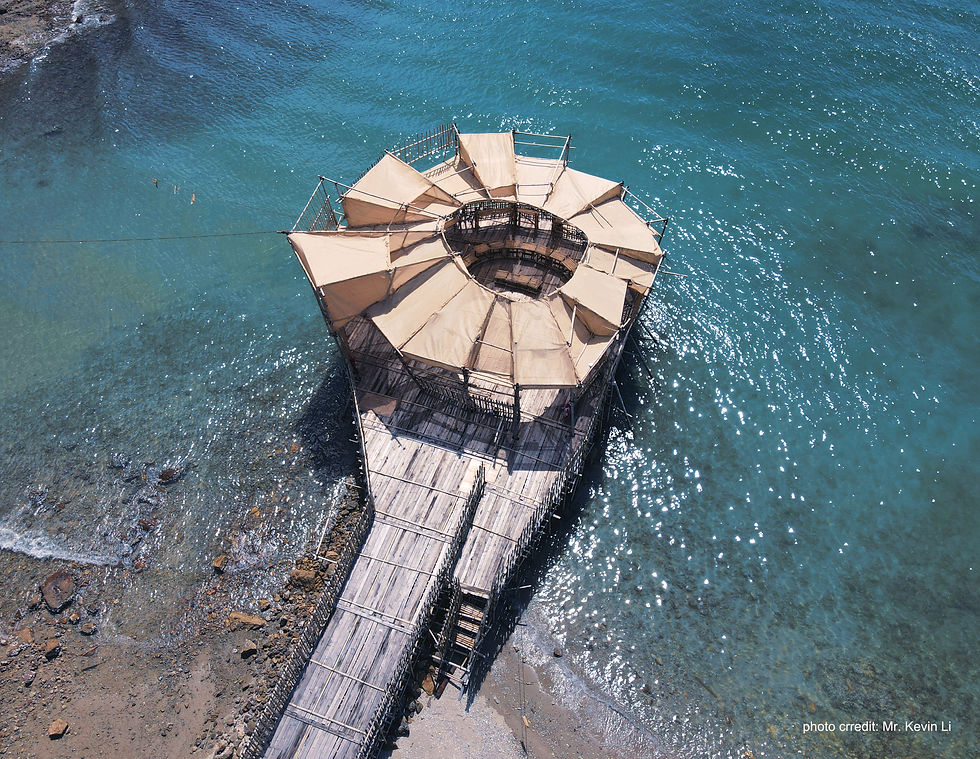
「E.CO Rotunda 竹.地.人.和」竹棚設計及策展項目內, 得到香港建築師學會(HKIA)年度大獎及英國皇家建築師學會(RIBA)亞洲建築慶典(RAFA)年度入圍獎。
聽了你在香港的歷程後,不難想到,你來倫敦是想尋找新的可能,不論是生活上,還是在你的本行建築學上。我知道你正在讀書,為什麼會有這個選擇呢?
讀書可以說是初來英國的一個緩衝,也是了解一個新城市和適應新生活的好方法。而正如我
之前所說,我不想再以最conventional的模式在這個行業繼續走,我覺得建築不只是行業中的一個崗位,有很多事在職場上其實無法做到,所以我想讀書去研究建築背後的心理學,這可以說是一塊我心中的missing puzzle。除了可以裝備自己之外,我希望從心理學角度去認識
建築還有甚麼可能性。我想集中去探討一些精神性的東西,還有一些在香港高度系統化的建築行業生態裏未能發展,卻對良好的環境設計非常重要的領域。
所以下定決心來倫敦之後,我去找想讀的科目,而我找到這一科──神經美學(Neuroaesthetics),它研究藝術和創作的心理學,算是心理學優先,
藝術次要。我很喜歡它把科學和藝術融合一起研究,也只有倫敦的金匠大學
(Goldsmiths, University of London)才有如此有趣的把神經配合藝術,兩者合一的科,這跟我想去探索建築和人類的關係很能相互映照,所以我就選擇住在倫敦先讀書。

你才初來倫敦,這個城市暫時給你的感覺是怎麼樣?
我來了兩個多月,我覺得生活最基本的衣食住行,雖然和香港很像,都是大城市,但始終文化差異上也要適應。例如是公共服務的模式,很多事要自己做,跟香港的顧客至上態度很不同,就是想改個地址,也要去銀行五次才成功。又例如坐車,在香港坐一個小時車和在倫敦坐一個小時車的體感是完全不同的。我也終於明白英國人為什麼一見面就說天氣,因為天氣很重要,每天都有變化,令你有很大感受。在亞洲,很多環境是conditioned的,我們留在室內的時間比較多,身體其實不需要怎樣去適應氣候,冬暖夏涼。但在這裡,我發現人跟環境的關係其實可以很緊密。
這些適應其實不是大問題,只是各樣微小的差異,要一一適應,有時也會累。上學時接觸到的人也讓我感受到文化差異,在語言溝通上,英文不夠英文作為母語的人好,我猜也需要一點
時間才可以真正融入,不過大家都是客氣和禮貌的。

除了讀書之外,你有沒有更多想追求的東西?
我猜由我自己出發去說吧,因為我不敢說有甚麼可以為別人做的。由自己出發,向自己好好
交代,把自己的長處和經驗好好發揮,就是我在追求的。
之前的建築經驗都是年紀給我的寶藏,我把它們帶來我新的exploration,可以用得到所學和所經驗的,去看看可以做到甚麼。我覺得人到中年,我盡量想簡單生活,我讀了幾個大範圍的科目:建築、藝術、心理,我發現知識很複雜,因為世界本身都很複雜,更不用說自身、身邊人、人生等等的複雜性。當有太多事無法同時處理,有時又out of control的時候,如果還想去追求很多,很容易會壓垮自己,會變得迷惘。
所以很多事情我會想去簡化,令自己不會overload。可以輕鬆地去看場戲,其實就已經
開心。

你會怎樣形容現在這一刻的你?此時此刻的狀態?
目前的我常常會想的是:怎麼樣把東西簡化?這個簡化是心理上的簡化,我會去試一樣新事物,但我不會把這個新事物變成很多的問題要去處理,純粹是去試,不需要訂甚麼大目標,
我發現我就不會再用壓力mode去生活。活在當下、享受每一個moment……,其實很老套,真是尷尬(笑),但又真的很對。
(筆者:你讓我想到英國一間很好的出版社The School of Life,他們有本書叫Small Pleasures,那是一本關於微小的快樂的書,很多時候,一個bubble bath、買喜歡的化妝品等等,微小快樂的累積,有時已經很夠,其實人生也就是這樣。)
沒錯,其實人生也很biological,腦和心靈,沒了其一都會塌下來。例如我現在來了英國,
我重啟每天在樓下跑步這件事,以前在香港時都有在做,因為運動是極重要。就算半小時
也好,它幫我detox,這是純粹的生物學,很神奇。
跑步帶給我的滿足,是用言語沒辦法形容的:當你跑完步,出了汗,汗水在皮膚上慢慢落下,你躺在草地上,氣很喘,身體很累,但草正給你安慰,加上陽光正好曬下來閃令令的視角,
那刻你會覺得,生命是值得的!大自然是與你同在,你不再孤單,你不是一個要去處理世上
各種煩事的機器。你是活著就是活著 ── 這是做運動才會有的感覺。
(筆者:這實在太浪漫了!不過我倒覺得,對一個人生沒有經歷過很多曲折的人來說,這種
感受未必會這麼深,有時就是要面對過許多的不如意之後,你才會覺得簡單的東西,原來是
這麼美麗!)沒錯,飲勝(笑)!
如果可以,你想……?
我想我的答案同樣是很老套的(笑)。我希望大家也覺得:活著是值得的。我覺得這個出發點很重要,因為當你自己感覺良好,你覺得你值得,不是說你做了甚麼豐功偉績,或者要對社會有甚麼很大的貢獻,而是活得很踏實、滿足、快樂,這幾個感覺加起來,如果每個人都可以是這樣,這個社會、這個世界其實就沒有邪惡了。
大家願意去貢獻,就是因為你覺得值得,你願意分享、給予、創造,而不會搶別人的,因為
你已經有、你已經content了,這樣的話世界會多些美好。這可能有一點宗教性,像宗教中的召命,如果你開心地去使用上天給你的恩賜,就可能達成「值得」這回事。或者,這就是我
為什麼希望在這個人生轉捩點踏出一步的原因吧。

明年今日,你會在做甚麼?
這好像新年願望一樣呢(笑)。我希望,在我現在這條嘗試的路上,可以看到清晰些的方向,或者可以實踐到一些小的東西,可能是一個展覽、一個final project,也可能是找到一個比較接近我想做事情的工作崗位,總之是希望多走一步;我也希望身邊多一點愛,多些可以互相
支持的人,跟身邊人建立多些關係,因為來倫敦也是一種切斷,要在這裡建立也好,跟前半生的自己的關係重新連結也好,其實也想有多些連結。

跟Haynie的訪問進行得十分流暢 ── 大概是因為這是我第一次可以用母語廣東話去訪問我的嘉賓吧!我知道她搬來倫敦時是把全副身家也搬了過來,行李總共有四十箱之多,問她為何有這樣的勇氣,她答:如果我這刻不動,就永世也不會動了!但她補充:真正到了倫敦之後,
又覺得其實真不是甚麼都不能回頭,也沒有「完全殺死自己再重生」那麼誇張,只是地域上
不同了,我仍有跟香港的朋友保持聯繫。
想起我八年前連床單被鋪都沒拿,只得一個黑色大行李箱和一個背囊就來了倫敦與兩位未見過的歐洲室友共住,更特意跟香港切斷聯繫一段頗長的時間,亦硬頸地不接受任何華人network的幫助 ── 那時的勇猛,應該就是Haynie口中的完全殺死自己再重生吧。來了太久又
「重生」了的我,在遭受種種無法與此地人融合的考驗後,覺得能有個在此地同聲同氣的
朋友,我其實比以前更懂珍惜了。
專欄簡介
用心生活的人都是值得欣賞的。在倫敦,我召集了十二位用心生活的人,他們有著不同的
背景、職業、愛好、生活方式,但共通的是,他們對生活有著熱情的心。我一一訪問,紀錄他們當前狀態,希望一年後,這個小小的時間囊會成為他們檢視生活的美好回憶。
作者簡介
大學中文系畢業、英國University of Leicester博物館及畫廊研究碩士。目前在倫敦某大型
文化藝術中心工作,並以教廣東話作為點綴;兩屆青年文學獎得主,作品曾刊《字花》、
《別字》等,著有專欄〈原來都走到這裡〉刊《大頭菜文藝月刊》。喜歡村上春樹、古典
音樂、伯爵茶和鄰居的貓。
Timeless London
#6 Haynie Sze
Date: 6 December 2025, 5 PM
Location: South London
Guest: Haynie Sze
I first met Haynie when I was nineteen. Back then, still a secondary school student, I loved attending literary talks and cultural events. Our first encounter must have been after an event in Kowloon City, when I went out with a group of Hong Kong writers for Thai food, and she was among them. We stayed in touch from then on. Since those early days, she has always called me “Mui mui (little girl in Cantonese)”, a tender and endearing way of addressing me. I knew she was an architect, and that she was also deeply drawn to art.
Our first “collaboration” came a few years later, when she took part in the Arts@Government Buildings programme (2013–14). Commissioned by the Home Affairs Bureau, she created an art installation titled Letters · Thoughts at the Central Post Office. Haynie invited people from across the cultural sector to write letters by hand, and I was fortunate enough to contribute two of my own. She reproduced these handwritten scripts onto the building’s windows, with the iconic circular windows of Jardine House opposite, creating an interesting dialogue that felt uniquely resonant.
Today, the Central Post Office, such an important landmark, is somehow facing demolition. I am no longer a “little girl” either; eight years ago, I came to the UK alone to begin a life here. Unexpectedly, Haynie later moved to London as well, embarking on a new chapter of her own. I thought: why not invite her to be a guest on Timeless London, to talk about architecture and art, the two threads that run deeply through her life?
We were both busy, so the interview took place online. Yet whenever the conversation grew animated, we found ourselves raising our glasses to the screen, as if we were sitting right beside each other.
Where are you from, and why are you living in London?
I’m from Hong Kong, and I’m an architect. I was born, raised, and I built my career there. I don’t mind sharing that I’m already in my forties — a middle-aged woman now (laughs). It was only at this age that I realised something: all my life,
I had been doing what was considered proper, correct, and expected of me. And I began to feel that something wasn’t quite right.
That sense of not right wasn’t about having failed on the surface. It was something deeper: a quiet feeling that something was missing, that certain things shouldn’t be this way. That feeling surfaced clearly, and it stayed with me.
My path had always been very clear, especially by Hong Kong’s standards. But I had long been suppressing my own desires until they finally pushed their way out. Of course, there were external factors too: social issues, what was happening in Hong Kong, the particular circumstances of my life… all coming together and prompting me to step out, to look for the missing piece of my puzzle. The UK allows us to stay for more than a year, and I thought, perhaps I could try living somewhere with less pressure.
Life has given me a great deal, and I feel that my second half cannot simply end like this. It would be a disservice to my own life. That sense of “something being off” is, in fact, a turning point. If I don’t turn now, I will only keep repeating what came before. So I chose to turn, to come to London, and to try doing what I truly want to do deep down.
Can you talk about your relationship with architecture? Why did you choose to become an architect?
Whenever I’m asked to introduce or describe myself, my profession is always the first thing I mention. It is my identity: I am an architect. Although my work is now shifting towards the arts, being an architect remains my core identity.
Looking back, I chose architecture largely because I was a very “well-behaved” child. I did well academically and was able to meet the expectations placed on me by society and by my parents. I was fortunate enough to be given some natural aptitude, and strong grades meant I could choose this field. But doing something well and truly liking it are not the same thing.
In secondary school, I was clearly more drawn to the humanities, yet I didn’t pursue them. In my generation, science subjects were seen as offering far more practical prospects. I knew very well that my strengths lay in language, visual thinking, and theory, but I set those aside and chose a science-based path that promised greater security, even if it wasn’t what I loved most.
My family background was modest. Once I graduated, I was expected to support my family, so when it came to choosing universities and majors, I filled my preferences with engineering subjects I wasn’t particularly interested in. I chose architecture because it seemed to sit somewhere between the humanities and the sciences:
you could draw, design, and create beautiful spaces, but you also needed theory and had to build things that functioned in the real world. To me, it felt like a compromise, a balance.
In the end, I gave up the humanities I truly loved and chose architecture, graduating from the Chinese University of Hong Kong, an amazing university.
What is the architectural profession actually like?
Architecture is a profession that demands a long-term commitment, a path that can take more than a decade to fully walk. From Year 1 at university, the degree itself takes five years, with a year of practical training in between, and then another two years of professional experience before you can even apply for a licence. You accumulate experience continuously, and then sit for the professional exams, usually two or three times before passing.
By the time your peers are settling down, starting families, and finding stability in their careers, your own journey is only just beginning. Even after you obtain your license, you may suddenly realise how little you actually know, because the field is vast. If you’ve worked on school buildings, you won’t necessarily understand residential projects; designing housing doesn’t prepare you for hospitals. These are entirely different worlds, with countless specialised roles and layers of expertise.
In practice, the work is highly repetitive and extremely systematic. The industry is tightly regulated, with fine divisions of labour and very large teams. Because of the complexity involved, an enormous number of people are always part of a project, nothing like what one imagines while studying. The so-called architectural masters are truly rare; it’s not as simple as standing on a construction site holding drawings and commanding everything around you.
The work is also physically and mentally demanding. Deadlines are relentless, designs have to be produced quickly, and revisions are endless. A single project meeting can involve representatives from at least twenty different disciplines: structural engineers, building services engineers, quantity surveyors, landscape architects, and beyond architecture itself, there are lighting designers, façade specialists, and many more.
If you are a sensitive person, deeply attached to your work, this profession can be especially difficult — and I am exactly that kind of person. I couldn’t simply complete my part and pass it on to the next person in the process. Perhaps someone more rational could manage that distance. Eventually, when the work became genuinely exhausting for me, I made the decision to leave that environment.
After you decided to leave your full-time role as an architect, did you have a clear direction or specific things you wanted to pursue?
No, not at all. What I’m doing now is a transition, and everything has to be explored step by step. This transition has been a gradual process. Between 2019 and 2021, when I had some space alongside work, I completed a part-time Master’s in Fine Art. It became an incredibly important window for me, a way into the world of art. Through which I began to explore, as an architect, what I could do through this medium?
I began to feel that traditional architectural roles didn’t have to be the only path. Architecture as a discipline is expansive, and I could approach it from a different angle. Art, in this sense, became another window through which I could look at architecture. During my Fine Art studies, I was constantly drawn back to spatial work: installations, three-dimensional pieces, the ideas behind them all stemmed from my reflections on the world, on society, and on the experience of the human body existing within space. For instance: how space constrains or pressures us; how it affects our mental and emotional states; and how, in response, we might reshape the spaces we inhabit. I was thinking about this cycle, again and again.
Of course, over the two years, I’ve also felt somewhat lost. The things I wanted to explore had no fixed framework, no clear guidance. It was very different from the clearly defined paths I’d always followed before. I had, in a sense, become a “humanities person.” After completing the degree, I formally resigned from my full-time architectural role. I experimented with many different things: conducting research in university architecture departments, working as a curator in art institutions, collaborating with artists from different disciplines in art spaces, making short films on spatial psychology, and teaching drawing and environmental design; and the project E.CO Rotunda: Bamboo · Land · People · Harmony,
an architectural installation, curation, and exhibition design project, even went on to win awards: the Hong Kong Institute of Architects Annual Award 2024, as well as a shortlisted award at the RIBA Asia Pacific Awards 2025.
Hearing about your journey in Hong Kong, it’s easy to imagine that coming to London was a way of searching for new possibilities — both in life and within your own discipline. I know you’re currently studying. Why did you choose to do so?
Studying can be seen as a buffer when first arriving in the UK, and also a good way to understand a new city and adapt to a new life. I want to focus on exploring more spiritual dimensions, as well as areas that are difficult to develop within Hong Kong’s highly systematized architectural industry, yet are crucial to creating genuinely good environments.
So I wanted to return to study to explore the psychology behind architecture, something that feels like another missing puzzle piece for me. Beyond equipping myself with new tools, I wanted to understand what other possibilities architecture might hold when viewed through a psychological lens. I wanted to focus on more intangible, inner dimensions.
Once I decided to come to London, I began searching for programmes that aligned with this direction, and eventually found one: Psychology of the Arts Neuroaesthetics & Creativity. It examines the psychology of art and creation, prioritizing psychology, with art as its secondary focus. What I love about it is the way it brings science and art together. And it’s only at Goldsmiths, University of London, that you find such an intriguing integration of neuroscience and art.
This focus resonates deeply with my desire to explore the relationship between architecture and human beings. That’s why I chose to settle in London first and study here.
You’ve only just arrived in London. What are your impressions of the city so far?
I’ve been here just over two months. In terms of daily necessities: food, clothing, housing, transport, London feels quite similar to Hong Kong. They’re both major cities. But culturally, there are still many adjustments to make.
Take public services, for example. Many things require you to handle them yourself; it’s very different from Hong Kong’s customer-first culture. Something as simple as changing an address might require five separate visits to the bank. Or take commuting: spending an hour on transport in Hong Kong feels entirely different from spending an hour on transport in London.
I’ve also finally come to understand why British people always talk about the weather when they meet, because it truly matters. It changes every day, and it affects you physically and emotionally. In much of Asia, environments are heavily conditioned. We spend more time indoors, and our bodies rarely need to adapt to the climate; we’re warm in winter, cool in summer. But here, I’ve come to realize that the relationship between people and their environment can actually be very intimate.
These adjustments aren’t major problems, but they accumulate. So many small differences, each requiring adaptation, and sometimes that can be tiring. The people I’ve met through school have also made me aware of cultural differences. In terms of language, my English still can’t compare to that of native speakers, and I imagine it will take time to truly integrate. That said, everyone has been polite and considerate.
Beyond your studies, is there anything else you’re hoping to pursue?
I think I can only answer this from myself, because I wouldn’t dare say what I might do for others. Starting from myself, being accountable to myself, and allowing my strengths and experiences to unfold properly, that is what I’m pursuing.
My past experiences in architecture are treasures that age has given me. I bring them into my current explorations, using what I’ve learned and lived through to see what might now be possible. As I’ve entered midlife, I’ve been trying to live more simply. I’ve studied several broad disciplines: architecture, fine arts, and psychology, and I’ve come to realise just how complex knowledge is, because the world itself is complex. Not to mention the complexities of the self, of relationships, of life as a whole. When too many things cannot be handled at once, when situations feel out of control, continuing to pursue too much can easily crush you, leaving you disoriented and lost.
So I’ve been trying to simplify, to avoid overloading myself. Sometimes, simply going to see a play, lightly and without expectation, is already enough to make me happy.
How would you describe yourself at this moment, your current state of being?
What I think about most right now is this: how can I simplify? And this simplification is psychological. I allow myself to try new things, but I don’t turn each attempt into a series of problems to solve. I try without attaching grand objectives. And I’ve realised that when I do this, I no longer live in “pressure mode.” Living in the present, enjoying each moment… it sounds terribly clichéd, almost embarrassing (laughs), but it’s also undeniably true.
(Iris: What you’re describing reminds me of The School of Life, the British publisher. They have a book called “Small Pleasures”, about finding joy in tiny things. A bubble bath, buying a favourite cosmetic product… sometimes the accumulation of small pleasures is already enough. Life, in many ways, is just this.)
Exactly. Life is also deeply biological. The body and the mind — if either collapses, everything collapses. Since coming to the UK, I’ve restarted my daily runs downstairs. I used to do this in Hong Kong as well. Exercise is essential. Even half an hour helps; it detoxes me. It’s pure biology, and it’s quite magical.
The satisfaction running gives me is beyond words. After you finish running, sweating, feeling the sweat slowly drip down your skin, you lie on the grass, breathless, exhausted — but the grass comforts you. The sunlight shines down, glittering. In that moment, you feel: life is worth living. Nature is with you. You are no longer alone. You are not a machine designed to handle endless worldly problems. You are alive, simply alive. This is a feeling only exercise can give.
(Iris: That’s incredibly romantic! But I sometimes feel that for people who haven’t experienced many twists and turns in life, this feeling may not come as deeply. Often, it’s only after facing enough disappointments that you realize how beautiful simplicity really is.)
Exactly. Cheers (laughs).
If you could wish for something…?
My answer is just as clichéd (laughs). I hope that people can feel that life is
worth living.
I think this starting point is crucial. Because when you feel good within yourself, when you feel that you are worthy — it’s not about having achieved something extraordinary, or having made some great contribution to society. It’s about living with groundedness, fulfilment, and joy — When these feelings come together, if everyone could live like this, then society, the world, would have far less evil.
People are willing to contribute because they feel it is worth it. They are willing to share, to give, to create, rather than take from others. Because they already have enough; because they are content. And when that is the case, the world naturally becomes a more beautiful place.
This may sound a little religious — like a calling. But perhaps, when you use the gifts you’ve been given with joy, you arrive at this sense of “worth.” Or perhaps that is precisely why, at this turning point in my life, I hope to take a step forward.
Where do you think you’ll be this time next year?
It sounds like a New Year’s wish (laughs). I hope that along the path I’m currently exploring, I’ll see a clearer direction or be able to put something small into practice. Perhaps an exhibition, a final project, or maybe finding a role that’s closer to what I want to do. In any case, I hope to move one step further.
I also hope for more love around me. The more people who can support one another, the more relationships can be built. Coming to London is a kind of cut-off; so whether it’s building new connections here or reconnecting with the earlier part of myself, I hope for more connections overall.
The conversation with Haynie flowed effortlessly, perhaps because it was the first time I’d interviewed a guest entirely in my mother tongue, Cantonese. I know that when she moved to London, she brought her entire life with her — more than forty carton boxes in total. When I asked where she found the courage, she said:
If I don’t move now, I’ll never move. She added, though, that once she arrived, she realised it wasn’t as irreversible as she’d imagined. It wasn’t a dramatic act of “killing oneself completely and being reborn.” It was simply a change of place, and she remains in close contact with her friends in Hong Kong.
It made me think of myself eight years ago, arriving in London with nothing but a large black suitcase and a backpack, not even bedsheets, and moving in with two European flatmates I’d never met. I deliberately cut off contact with Hong Kong for a long while, stubbornly refusing help from any Chinese network. That ferocity, perhaps, was what Haynie meant by completely killing oneself and being reborn.
Having lived here long enough to be “reborn” more than once, and having faced countless moments of not quite fitting in, I now find myself cherishing something I once took for granted: the quiet comfort of having a friend who speaks the same language, shares the same rhythms, in this foreign place. More than ever before,
I know how precious that is.
(Originally written in Traditional Chinese.)
About This Column
People who live mindfully are always worth appreciating. In London, I gathered twelve individuals who each live with intention. They come from different backgrounds, careers, interests, and lifestyles, but they all share a passion for life. I sat down with each of them to capture a snapshot of where they are right now. A year from now, I hope this little time capsule brings them warm memories as they reflect on how far they’ve come.
About the Author
Iris Yee-Ting Chow, (Official Website) born and raised in pre-1997 Hong Kong. Moved to the UK in 2018 and has been here ever since. Holds a degree in Chinese Language and Literature from Hong Kong, and a master’s in Art Museum and Gallery Studies from the University of Leicester, UK. Currently works at a major art and culture centre in London and moonlights as a Cantonese teacher.
Twice awarded the Hong Kong Youth Literature Award. Work has appeared in Fleurs des Lettres and Typo. Writes the column ‘So This Is Where I’ve Come To‘ for The Turnip Arts Journal. A lover of Haruki Murakami, classical music, Earl Grey tea, and the neighbour’s cat.


Comments